

You’re planning a school field day, and you’ve heard that a 38ft obstacle course is the sweet spot for keeping 200+ kids entertained without creating bottlenecks. But when you look at your playground or gym, the first question hits: will this actually fit?
Understanding the real-world dimensions of a 38ft obstacle course rental—not just the advertised length, but the total footprint, height clearance, and flow space—makes the difference between a smooth event and a last-minute scramble. This guide breaks down what “38 feet” actually means, how many kids it handles, and what you need to measure before you book.
Whether you’re setting up indoors in a gym or outside on a football field, you’ll know exactly what to expect.
📋 What’s Covered in This Guide
🎓 Planning a School Event
You need to know if this fits in your gym, how many kids it holds, and whether it’ll keep 3rd-5th graders engaged for a full rotation schedule.
🏡 Hosting a Large Backyard Party
You’re wondering if your yard is big enough, whether your kids’ ages work with this size, and how it compares to smaller options.
🎪 Organizing a Community Festival
You need to calculate total footprint with safety zones, understand throughput for crowd management, and confirm power requirements.
Actual Dimensions of a 38ft Obstacle Course
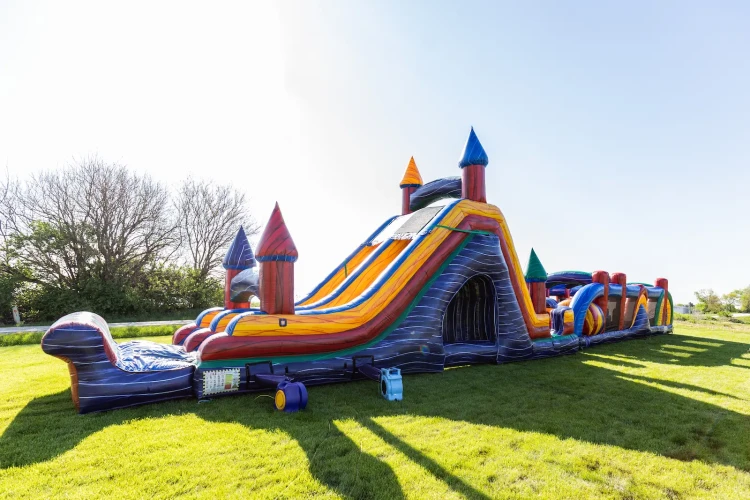
When a rental company lists a 38ft obstacle course, that measurement refers to the length of the inflatable from entrance to exit. But that’s not the full story—you need to account for width, height, and the safety clearance required around the entire unit.
Here’s what the typical setup footprint looks like:
| Measurement | Dimension | What This Includes |
|---|---|---|
| Length | 38 feet | Entrance to slide exit |
| Width | 10-12 feet | Side-to-side span; varies by model |
| Height | 15-22 feet | Ground to tallest point (usually the slide) |
| Recommended Setup Area | 48 ft × 20 ft | Includes 5 ft clearance on all sides for stakes, blower, and safe entry/exit zones |
| Minimum Ceiling Height (Indoor) | 22-25 feet | Required vertical clearance for tallest models |
Key takeaway: The inflatable itself is 38 feet long, but you need a 48-foot-long × 20-foot-wide clear zone to set it up safely. This accounts for anchor stakes (which extend 3-4 feet outward), the blower unit, electrical cord routing, and safe queuing space at the entrance.
💡 Pro Tip: If you’re setting up indoors, measure your ceiling height at the lowest point—not just the peak. Gym light fixtures, basketball hoops, and HVAC ducts can create unexpected height restrictions even if the center of the gym is tall enough.
Space Planning: Indoor vs Outdoor Setup
The setup requirements for a 38ft obstacle course shift significantly depending on whether you’re placing it indoors or outdoors. Each environment introduces unique spatial and logistical considerations.
Indoor Setup (Gyms, Multipurpose Rooms)
Indoor venues offer weather protection and controlled environments, but they come with strict dimensional limits.
- Ceiling Height: Most 38ft obstacle courses with tall slide exits require 22-25 feet of clearance. Standard elementary school gyms often have 20-22 foot ceilings—borderline for many models.
- Floor Protection: Use tarps or gym floor coverings under anchor points to prevent scuffing. Inflatables themselves won’t damage floors, but metal stakes and blower bases can.
- Electrical Access: You’ll need a dedicated 15-amp or 20-amp circuit within 50 feet of the setup location. Confirm with your facility manager before booking.
- Entry/Exit Flow: Indoors, you have limited space for queue lines. Position the entrance near a wall or corner to maximize open floor space for spectators.
⚠️ Caution: If your gym has retractable bleachers, measure with them fully extended. Many schools forget this and discover on event day that the setup area is 10 feet narrower than anticipated.
Outdoor Setup (Fields, Playgrounds, Parking Lots)
Outdoor setups offer unlimited height clearance and easier access, but surface conditions and weather become factors.
- Surface Type: Grass, turf, or rubberized playground surfaces are ideal. Asphalt and concrete work but require sandbags instead of stakes for anchoring (adds 2-3 feet to the footprint).
- Overhead Clearance: Check for tree branches, power lines, or building overhangs. A 22-foot-tall slide can’t be positioned under a 20-foot tree canopy.
- Power Source: Outdoor events often require a generator if electrical outlets aren’t within extension cord range (most rental companies provide generators for an additional fee).
- Weather Contingency: Inflatables can’t operate in winds above 15-20 mph or during rain. Have an indoor backup plan or reschedule policy in place.
Slope considerations: The setup area must be relatively flat—no more than a 5-degree incline. A sloped surface causes uneven inflation and creates safety hazards as kids exit the slide.
✅ Outdoor Advantages
- No height restrictions
- Easier delivery and setup access
- More space for spectators and queuing
- Natural ventilation for blower noise
⚠️ Outdoor Challenges
- Weather dependency (wind, rain, lightning)
- Surface conditions (gravel, mud, uneven ground)
- Power access (may need generator rental)
- Sun exposure (shade tents recommended for long events)
How Many Kids Can Use It at Once?
Capacity for a 38ft obstacle course depends on design layout and age group, not just size. Most models accommodate 8-12 participants simultaneously when you account for kids at different challenge stations.
Here’s how capacity breaks down in real-world use:
Capacity by Course Section
- Entrance/Climb Wall: 2 kids entering or climbing simultaneously
- Mid-Course Obstacles: 4-6 kids navigating tunnels, squeeze walls, or pop-ups
- Slide Exit: 2-3 kids queued or sliding (if dual-lane design)
Total active capacity: 8-12 kids inside the obstacle course at any given moment.
Throughput: How Many Kids Per Hour?
If you’re planning a school field day with rotation schedules, throughput matters more than instantaneous capacity.
- Average completion time: 45 seconds to 2 minutes per child
- Realistic throughput: 30-50 kids per hour with continuous flow
- Supervised event pacing: 20-30 kids per hour if you’re batching groups for safety
For a school event with 200 students, plan for 4-6 hours of rental time if this is one of several activity stations. If it’s the main attraction, you’ll need 6-8 hours to give every child 2-3 turns.
💡 Pro Tip: Age grouping dramatically improves flow. Separate kindergarten-2nd graders from 3rd-5th graders. Younger kids take longer and benefit from adult spotting, while older kids move faster and prefer competitive racing.
Recommended Age Range
Most 38ft obstacle courses are designed for ages 5 and up, but the sweet spot is ages 6-14. Here’s why:
- Ages 5-7: Can complete the course but need supervision and encouragement. Climb walls may require spotting.
- Ages 8-12: Ideal age range—strong enough for physical challenges, competitive enough to stay engaged, young enough to find it thrilling.
- Ages 13+: Still enjoy it but may finish too quickly unless you run timed races or competitive heats.
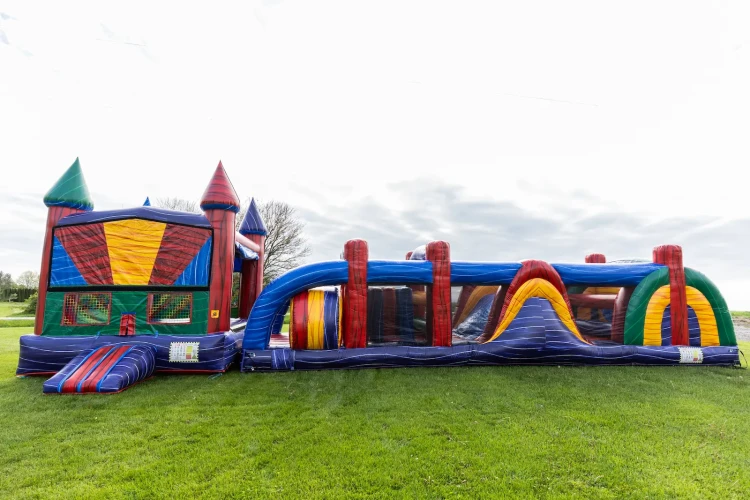
Comparing 38ft vs 22ft Obstacle Courses
Choosing between a 38ft and a 22ft obstacle course isn’t just about size—it’s about event duration, participant age, and engagement level. Here’s how the two compare in practical terms.
22ft Obstacle Course
Quick Fun | Compact Setup
- ✓ Fits in smaller yards and gyms
- ✓ Lower height requirement (12-15 ft)
- ✓ Faster completion time (30-60 seconds)
- ✓ Better for younger kids (ages 4-8)
- ✓ Lower rental cost
- ✗ Less challenge for older kids
- ✗ Shorter entertainment value
38ft Obstacle Course
Full Challenge | Event Centerpiece
- ✓ Longer engagement (1-2 minutes per run)
- ✓ Multiple challenge elements (climb, squeeze, slide)
- ✓ Better for ages 6-14
- ✓ Higher throughput capacity (8-12 kids at once)
- ✓ More impressive visual centerpiece
- ✗ Requires more space (48 ft × 20 ft)
- ✗ Needs taller ceiling (22-25 ft)
Which Should You Choose?
Decision Framework
Choose 22ft if:
- Your event is under 2 hours
- Most kids are under age 8
- Space is limited (small gym or yard)
Choose 38ft if:
- Your event is 3+ hours (like a field day)
- Ages range from 6-14
- You need sustained engagement and throughput
For context, a full obstacle course rental guide breaks down the decision factors across all size ranges, from compact 15ft toddler courses to 50ft+ competitive models.
Common 38ft Obstacle Course Models
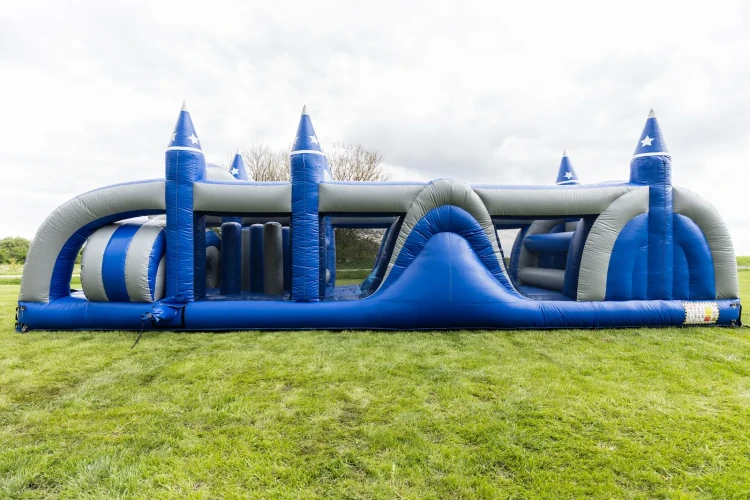
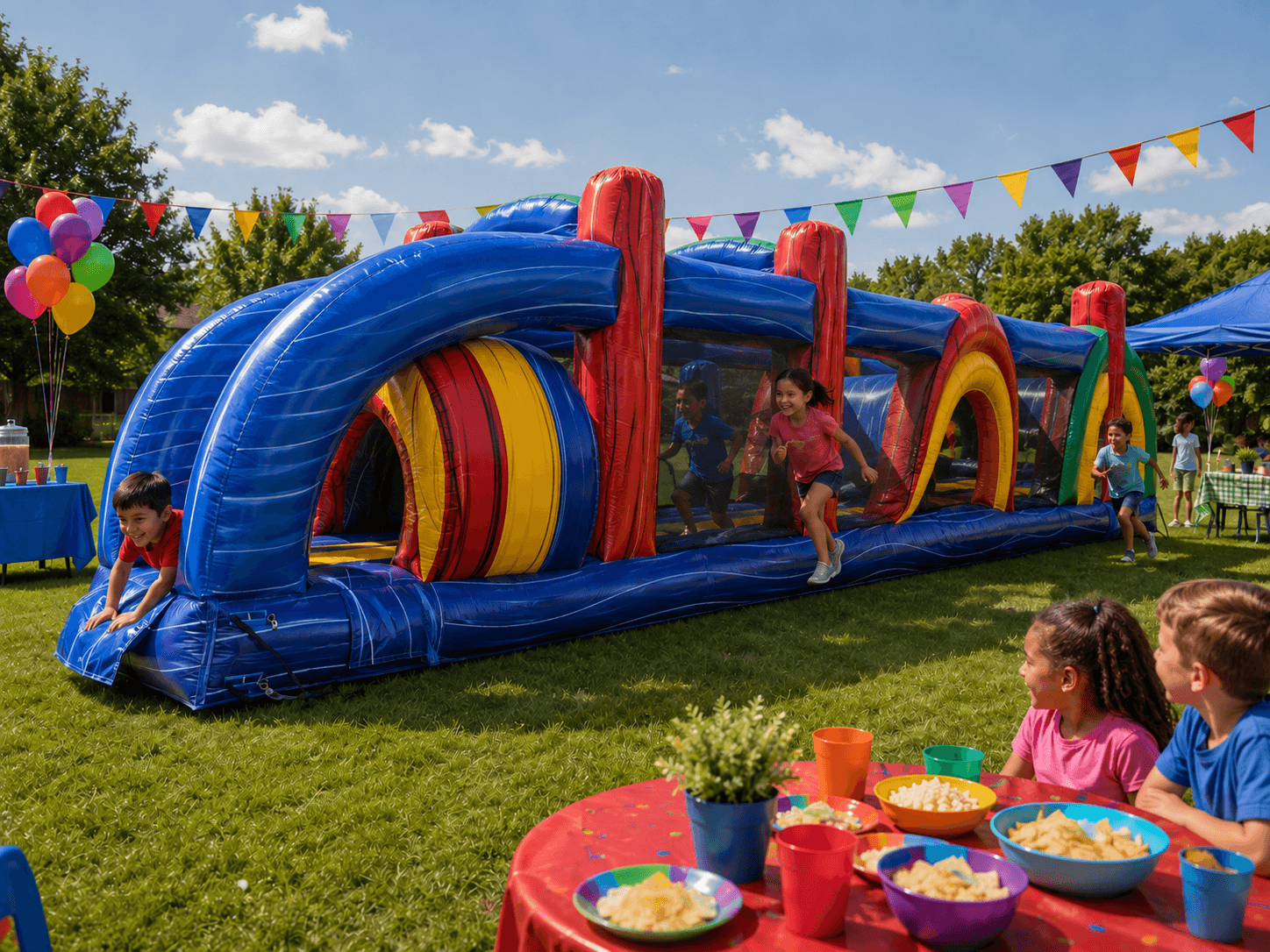
Not all 38ft obstacle courses are identical. Layout, theming, and challenge elements vary significantly across models. Here are the most common designs you’ll encounter when browsing rental inventory.
Dual-Lane vs Single-Lane Layouts
The internal layout significantly affects throughput and engagement style:
- Dual-Lane Courses: Two kids race side-by-side through identical obstacle paths. Better for competitive events, faster throughput, and kids who thrive on racing dynamics.
- Single-Lane Courses: One continuous path with varied obstacles. Better for younger kids, cooperative play, and events where you want less competitive energy.
Most 38ft courses use a hybrid model—single lane through climbing and crawling sections, then dual lanes at the slide exit to prevent bottlenecks.
⚠️ Note on Slide Height: Some 38ft courses feature 22ft tall slides, which require 25+ foot ceiling clearance indoors. Always confirm the exact model when booking for indoor events—”38ft obstacle course” is a length measurement, not a height specification.
What Rental Companies Consider When Quoting Setup
When you request a quote for a 38ft obstacle course rental, experienced companies assess more than just whether it physically fits in your space. Here’s what they’re evaluating behind the scenes.
Site Assessment Checklist
- Access Path: Can the deflated unit (typically rolled into a 3 ft × 3 ft × 6 ft bundle weighing 200-300 lbs) be carried or carted from the truck to the setup location? Stairs, narrow hallways, and locked gates create logistical issues.
- Ground Surface: Grass allows for stake anchoring. Concrete/asphalt requires sandbag anchoring, which adds time, cost, and footprint (2-3 extra feet around the perimeter).
- Electrical Distance: Standard extension cords reach 50 feet. If the nearest outlet is farther, you’ll need a generator (adds $75-150 to rental cost).
- Overhead Clearance: Not just height, but lateral clearance during setup. Inflatables expand outward as they inflate—nearby walls, fences, or equipment can interfere.
- Participant Flow: Where will kids queue? Where do parents stand? Is there a clear exit path that doesn’t block emergency access?
Professional rental companies often request photos or videos of the setup location before confirming a booking. This isn’t bureaucracy—it prevents day-of-event surprises that waste everyone’s time.
💡 Pro Tip: When photographing your setup area, include a tape measure or ruler in the frame for scale reference. Also photograph the electrical panel location and any overhead obstacles. This helps rental companies provide accurate quotes without needing a site visit.
What Increases Setup Complexity (and Cost)
🚩 Setup Red Flags
- More than 100 feet from truck parking to setup site
- Stairs or steep slopes in the access path
- Gates narrower than 4 feet
- Overhead tree branches or power lines within 5 feet
- Ground surface is gravel, mulch, or heavily sloped
- No electrical outlet within 75 feet
✅ Ideal Setup Conditions
- Flat, level grass or turf surface
- Direct access from parking area (no obstacles)
- Clear 50 ft × 25 ft open space
- Electrical outlet within 50 feet
- No overhead obstructions within 30 feet
- Shaded area for blower unit (reduces noise and heat)
If your site has red flags but you still want to proceed, communicate them upfront during booking. Most rental companies can work around challenges with advance notice—but discovering them on event day can delay setup by hours or make installation impossible.
Frequently Asked Questions About 38ft Obstacle Course Rentals
How many kids can use a 38ft obstacle course at once? +
A 38ft obstacle course typically accommodates 8-12 kids at a time, depending on the specific layout and number of lanes. Most designs feature dual lanes or multiple stations that allow several participants to move through simultaneously while maintaining safe spacing. Actual throughput is 30-50 kids per hour with continuous supervised flow.
What dimensions should I expect for a 38ft obstacle course rental? +
A standard 38ft obstacle course measures approximately 38 feet in length, 10-12 feet in width, and 15-22 feet in height depending on the model. You’ll need to account for a setup area that’s about 5 feet wider and longer on all sides for safe clearance and anchor points—typically a 48 ft × 20 ft total footprint.
Will a 38ft obstacle course fit in a standard school gym? +
Most standard school gyms can accommodate a 38ft obstacle course. A typical high school gym measures 84 feet by 50 feet, which provides ample space. However, you must verify ceiling height—most 38ft courses require 18-25 feet of vertical clearance, especially models with tall slide components. Elementary school gyms with 20-foot ceilings may be borderline for certain models.
How long does it take kids to complete a 38ft obstacle course? +
Most kids complete a 38ft obstacle course in 45 seconds to 2 minutes, depending on age, skill level, and how competitive they’re feeling. Younger children (ages 5-7) typically take longer, while older kids and teens move through more quickly. This timing allows for good rotation during school field days and keeps lines moving without feeling rushed.
What’s the difference between a 38ft and 22ft obstacle course? +
A 38ft obstacle course offers nearly double the challenge elements and entertainment time compared to a 22ft version. The longer format typically includes more climbing walls, squeeze-through sections, and often a taller slide exit. It’s better suited for older kids (ages 8-14), larger groups, and events lasting 3+ hours where you need sustained engagement. The 22ft version works well for shorter events and younger children (ages 4-8).
Do I need special insurance to rent a 38ft obstacle course for a school event? +
Most school districts require proof of general liability insurance from the rental company, typically $1-2 million coverage. The rental company usually provides a certificate of insurance listing your school as an additional insured at no extra charge. Some districts also require the rental company to carry commercial auto insurance for delivery vehicles. Always confirm your district’s specific requirements during initial booking.
Understanding Your Space Sets You Up for Success
The “38 feet” in a 38ft obstacle course tells you the entertainment value and challenge level, but the real planning happens when you measure the full footprint—length plus clearance, width plus anchoring space, and height including your tallest overhead obstruction.
When you know that you need a 48 ft × 20 ft clear zone, 22-25 feet of vertical space, and electrical access within 50 feet, you can confidently book the right equipment for your event—whether that’s a school field day, a backyard graduation party, or a community festival.
Most importantly, you’ll avoid the day-of-event scramble that happens when “it should fit” becomes “we can’t set this up safely.” Professional rental companies appreciate customers who’ve done their homework—it makes their job easier and your event smoother.
If you’re planning a larger event and considering multiple inflatables, our bounce house rental guide and water slide rental guide offer similar spatial planning frameworks for those categories.
Need Help Planning Your Event Setup?
We’re happy to walk through your space, answer questions about specific models, and help you choose the right obstacle course for your event—no pressure, just straightforward guidance.
Contact UsOr call us at (219) 688-9594